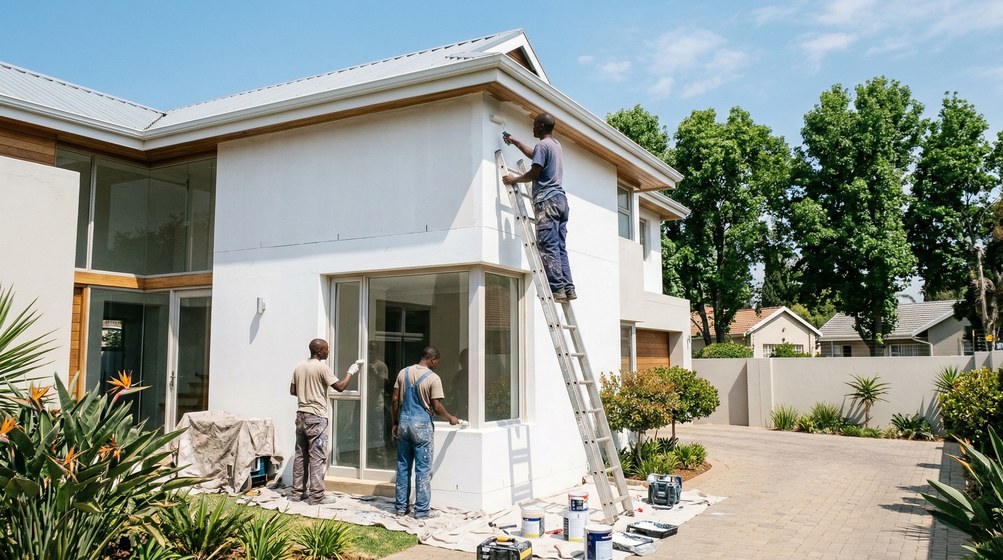
- Get a free on-site quote with coastal preparation written into the scope, not added as an extra
- Specified for sea-facing exposure — salt wash-down, chloride removal, UV and wind-rated systems
- We plan around the south-easter instead of painting through it
Painting a House That Faces the Sea
Table View exteriors take more punishment than almost anywhere else in the metro, and the failure mode is specific. Three forces work on the wall at once: airborne salt, wind-driven sand, and unshaded UV coming off a flat, open landscape. A paint system that would run eight years two suburbs inland will show its age here in four if it is not specified and prepared for the coast.
Salt is the one that does the invisible damage. Chloride settles on every exterior surface, and if the wall is only rinsed rather than washed, those salts stay under the new film. Being hygroscopic, they draw moisture through the coating and lift it off the substrate from behind — which is why coastal paint failure so often shows up as blistering and sheet peeling rather than the fading and chalking you see inland. A proper wash-down that dissolves and carries the chlorides away, followed by drying to a measurable moisture level, is not an optional extra here. It is the job.
Wind-driven sand is the second. During the south-easter season the abrasive load on a west and south-west elevation is enough to visibly erode a soft film over a few years, and sand landing on wet paint embeds permanently. It also makes spraying impractical on many days.
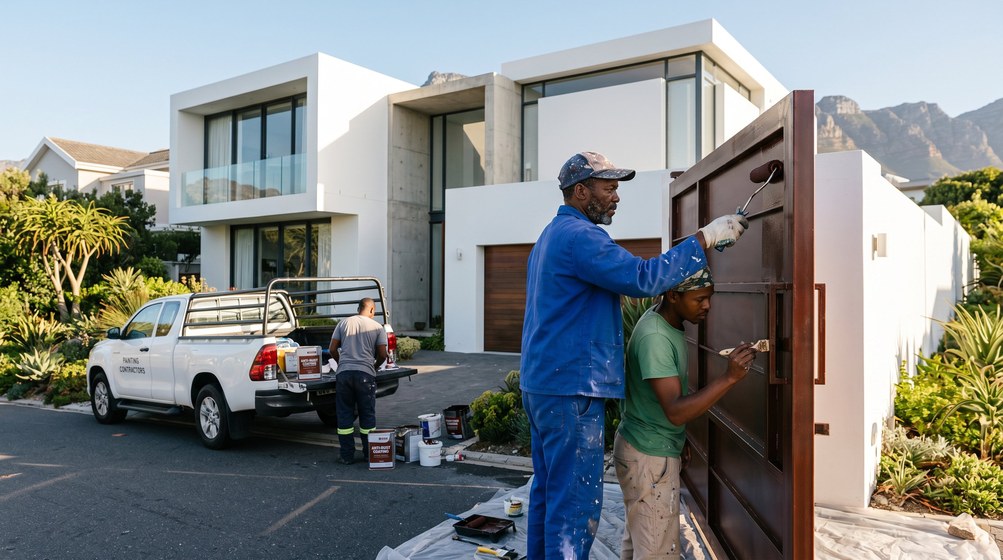
The third factor is metal. Garage doors, balustrades, burglar bars, gate motors, gutter brackets and window furniture corrode far faster in Table View than inland. Any ferrous metal on a sea-facing elevation needs a genuine primer system, not a rust-converting paint applied over flaking rust. Getting this right is usually the difference between recoating the metalwork every six years and replacing it every ten.
What Painting Costs in Table View
| Job | What it covers | Indicative price |
|---|---|---|
| Interior repaint, 3-bed | Walls and ceilings, approx. 170 m² | R23,000 – R40,000 |
| Exterior repaint, single storey | Including salt wash-down and chloride removal | R32,000 – R58,000 |
| Exterior repaint, double storey, sea-facing | Access and coastal preparation included | R58,000 – R105,000 |
| Salt wash-down and chloride removal | Where quoted separately, whole house | R3,500 – R11,000 |
| Aluminium and timber joinery | Prepared and recoated, per opening | R900 – R2,600 |
| Flat or low-pitch roof waterproofing | Per m², membrane plus reflective topcoat | R220 – R430 |
All-in ranges for labour, materials, preparation and two coats. Coastal exteriors sit above equivalent inland prices because the preparation is genuinely more work — a quote at inland rates almost always means the salt preparation has been left out.
Painting Around the South-Easter
Table View has a narrower usable window than inland suburbs, because two different constraints bite at opposite ends of the year. May to August is out for rain and slow drying. Late November to early February is largely out for wind: the south-easter through Table View is strong and carries fine sand, which contaminates wet film, makes spraying unworkable and blows overspray across neighbouring properties.
That leaves two reliable stretches. Mid-September to mid-November is the first and the better of the two — dry, moderate wind, and enough consecutive clear days to complete the wash-down, drying and coating sequence without a break. Late February to mid-April is the second, with the advantage that the walls are at their driest after a full summer, which matters if any damp or blistering is being investigated.
Within a day, the sequencing is the same as anywhere on the coast: start on the elevation that is out of the wind and follow the shade. On a sea-facing wall in midsummer the combination of direct sun and constant airflow can dry an acrylic film faster than it can level, which shows up as lap marks and roller texture.
If a contractor offers to start your Table View exterior in December because they have availability, that availability is telling you something.
A Coastal Specification That Actually Lasts
The difference between a four-year and an eight-year coastal repaint is almost entirely preparation and primer choice. The topcoat matters, but it matters less than people assume.
- Exterior walls: a premium 100% acrylic with high UV resistance and a flexible film — Plascon Micatex or Dulux Weatherguard. Micatex covers around 5 m² per litre per coat, so do not let anyone stretch it to hit a price
- Before anything: a full wash-down that removes chlorides, then drying to a measured moisture reading. Rinsing is not washing, and this single step drives the lifespan of the whole job
- Ferrous metal — balustrades, burglar bars, gates, brackets: rust removed mechanically to bright metal, then a zinc-phosphate or epoxy primer, then a durable topcoat. Rust-converter paint over flaking rust is a one-season fix here
- Galvanised gutters, downpipes and sheeting: an etch primer first, always. Acrylic straight onto galvanising peels off in sheets on the coast
- Aluminium joinery: a dedicated etch primer and a high-performance topcoat, or leave it and simply clean it. Standard enamel will not hold
- Timber decks, pergolas and sea-facing joinery: a UV-stable exterior sealer with recoating every 12 to 18 months on the exposed side. Timber that faces the sea is a maintenance item, not a once-off
- Flat and low-pitch roofs: a proper waterproofing membrane with a reflective topcoat, not roof paint
What to Insist On in Table View
- The quote must state a salt wash-down and chloride removal. If it says only "clean and prepare surfaces", ask what that means in practice
- Ask what primer is specified for each different substrate — plaster, galvanised, bare steel and aluminium all need different products
- Ask what the wind plan is. A contractor who intends to work through a strong south-easter will hand you a gritty wall
- Get the metalwork itemised. On a sea-facing house it can be 20% of the exterior cost and it is the first thing cut from a cheap quote
- Book the shoulder seasons, not December. Availability in the peak wind weeks is not a bargain
- Ask what recoat interval the contractor expects from the system they are quoting. If they say ten years for a coastal exterior without qualification, be sceptical
Services We Cover in Table View
- Exterior painting
- Anti-rust coatings
- Waterproofing
- Interior painting
- Wood staining and sealing
- Roof painting
Table View Painting Questions
Painting a home in Table View? Contact Painters Sunset Beach for a coastal specification and an itemised quote.
painters Table View, coastal house painting Table View, salt damage paint Table View, exterior painting cost Table View, anti rust coating Table View
Get a Free Quote in Table View →5-Star Reviews
Powered by leaderr